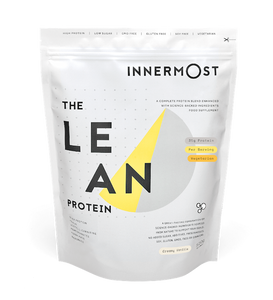











Protein powders are a super useful tool in any wellness-enthusiast’s arsenal, but unfortunately one size does not fit all here. You might have landed here because you can’t have lactose, don’t wish to for one reason or another, or maybe just because you’re always curious about different aspects of nutrition (and we love that).
Whatever your motivation for finding out more about lactose-free protein powders, this guide will walk you through why some people choose to skip the lactose, what the main alternatives and benefits are (as well as how they differ), and how Innermost can help you find the perfect protein powder for your personal goals.
Enough of the preamble, let’s get into it!
Why choose a lactose-free protein powder?
Lactose intolerance, allergies or digestive sensitivity
Whether you’re lactose intolerant or not, many people can find they experience some discomfort when they consume lactose-based protein powders. Typical symptoms include bloating, gas, diarrhoea or just general stomach discomfort – in short, it’s not pleasant.
This isn’t just for the minority either, as it’s estimated that around 68% of the world’s population have some form of sensitivity to lactose1. In the pursuit of better health, there’s no need to put yourself through discomfort to get the nutrition you need – especially with today’s wide range of alternative protein options.
Lifestyle or ethical choices
Aside from physical issues, many people choose to avoid lactose for a variety of personal reasons. For those following a vegan diet, lactose is an obvious miss due to its dairy origins, with many others looking for ways to reduce their consumption of animal-derived products wherever possible. In addition, while lactose can be halal compliant, this isn’t always the case if it contains certain additives.
Common alternatives to lactose-based protein powders
So, plenty of people are looking for lactose-free protein powders but what are the top options? Let’s break them down.
The benchmark – lactose-based proteins
We often hear the question, ‘is whey protein lactose-free?’ – unfortunately, the answer is no. Whey protein originates from milk and therefore contains lactose.
However, whey protein is a very effective protein supplement and what many consider as the benchmark for protein powders. It’s high in essential amino acids and offers rapid absorption, making it a perfect option for post-workout refuelling.
Saying that, as they are the most abundant on the market, there are also quite a few low-quality whey proteins out there. To drive the price down as much as possible, they can be chock-full of:
- Artificial flavours
- Fillers
- Bulking agents
- Artificial colours
But not ours.
If lactose isn’t an issue for you, check out our Innermost range of whey protein powders – we think you’d like them.
The alternatives - plant-based/lactose-free proteins
The most common lactose-free protein alternatives include soy, pea, brown rice and blended plant proteins. Here, we’ll cover each of those and look at how they differ from each other to help you pick out your best option.
|
Protein Type |
Key Science-Backed Benefits |
Possible Limitations |
|
Soy Protein Powder |
• Complete amino acid profile. • Can lower “bad” cholesterol, supporting heart health. • Contains isoflavones which may support bone health, menopause symptom relief, and post-exercise recovery. |
• Not the most perfectly balanced profile of amino acids. • Absorption is a little slower than whey. • Not suitable for those with soy allergies. |
|
Pea & Brown Rice Protein Blend |
• Their complementary amino acid profiles make a complete plant protein. • Shown to stimulate muscle protein synthesis on par with whey protein after resistance training. • Easily digestible, hypoallergenic, vegan and lactose-free. |
• Can have a gritty texture or earthy taste if unflavoured (not a problem with our special Innermost blend). |
|
Other Plant Proteins (Hemp, Pumpkin Seed, etc.) |
• Provide extra nutrients such as omega-3s, magnesium and zinc. • Offer antioxidant and anti-inflammatory properties beyond protein. |
• Typically lower total protein per serving than soy or pea/rice blends. • May have a stronger, nutty flavour which doesn’t suit all palates. |
Soy protein
Soy protein, made from soy beans, is one of the most high protein plant sources and is a ‘complete protein’ (meaning it contains all nine essential amino acids).
It’s a great dairy and lactose-free protein option, although it isn’t quite as easily absorbed as whey and the amino acid profile isn’t as well balanced as some other options – for example, it contains a little less leucine.
Soy protein’s flavour profile is smooth and pretty neutral, but some blends can have a mild nutty or ‘beany’ flavour to them.
To summarise, the top benefits of soy protein powder are:
- It provides a complete essential amino acids profile2 (not something all plant proteins can do).
- Clinical evidence shows replacing animal protein with soy could lower levels of “bad” cholesterol3, keeping your heart in good shape.
- Soy also contains bioactive compounds which may help in menopause, bone health and post-exercise recovery4.
Pea and brown rice protein
Laurel and Hardy, Batman and Robin, pea and brown rice protein… maybe a bit of a reach but who doesn’t love a quality double act?
On their own, pea and brown rice proteins are good but they don’t offer the most balanced profiles. That’s why many modern lactose-free protein powders make use of a blend of the two, building a very balanced amino acid profile which rivals that of whey.
Pea protein provides lysine, brown rice protein adds methionine – together, they’re a dairy-free powerhouse. That’s why this is our go-to when it comes to lactose-free or vegan proteins.
We’ve spent a lot of time perfecting our blend to provide a smooth, tasty alternative protein option and we think we’ve cracked it. Check out our range of pea and brown rice vegan proteins to see for yourself.
To summarise, the top benefits of pea and brown rice protein powder are:
- Combining pea and brown rice proteins offers a complete amino acid profile, with more balance between amino acids than some other plant sources.
- Research suggests a pea/rice blend can match whey protein for stimulating muscle protein synthesis after exercise5.
- These proteins are dairy-free, hypoallergenic and fully vegan.
Other plant protein sources
Alongside these two front-runners, there are a host of other plant-sourced protein powders to choose from. These include hemp, pumpkin or sunflower seeds, and pea or rice alone.
The biggest benefit to these other sources is their rich profile of nutrients, such as fibre and various minerals, however they do typically offer a lower protein concentration.
Depending on which one you pick, the flavour profile will likely differ greatly and some of these offer a slightly grainy texture. If you’re looking to use one of these, we’d recommend mixing it into smoothies or other bases for a better flavour experience.
To summarise, the top benefits of other plant-based protein powders are:
- Hemp-seed and pumpkin-seed protein powders (for example) offer extra nutrients (like omega-3 fatty acids, magnesium or zinc) as well as protein6.
- These extra nutrients offer antioxidant and bioactive properties beyond protein, which can offer a number of other benefits.
- Keep in mind though, whilst they do offer a wider spectrum of nutrients, the concentration of protein found here is often lower.
How Innermost can help – our lactose-free protein powders
At Innermost, our focus has always been on following the science and using the highest quality ingredients across every product we offer.
Our lactose-free protein powders are free from artificial fillers, bulking agents, colours and major allergens, and are designed to give you all the benefits a protein supplement should, whether or not you consume lactose.
With this in mind, let us give you a whistlestop tour of our top lactose-free protein options.
Some of our favourites
- The Health Protein: Vegan, dairy and lactose-free with 31g protein per serving – powered by pea and brown rice protein. Designed to give you the protein you need whilst also supporting your immune system.
- The Fit Protein: Also vegan, dairy and lactose-free with 31g protein per serving – no compromises. Formulated for hydration and energy, this is the ideal protein pick for people looking to push themselves further than most.
How to choose the right lactose-free protein for you
Choosing the right protein powder for you is a case of asking yourself a few simple questions:
- What are my dietary restrictions? Lactose-free? Dairy-free? Vegan? This will help you narrow down your options pretty quickly
- What are my goals? Do you want to build muscle? Recover from gruelling workouts? Manage your weight? Boost your immunity? Find a protein powder which is suited to your goals, whatever they are
- Do I have any sensitivities to ingredients and would rather avoid them? Even some plant proteins can have ingredients you might react to – make sure to read the full ingredients list before you put anything in your body
- What are the recommended servings? Some plant proteins can need larger serving sizes to achieve your desired amount of protein. Make sure this fits within your budget and taste preferences. If in doubt, try a trial pack first!
Whatever your reason, we made it easy
Whether lactose makes you blow up like a balloon or you’re looking to avoid animal products, there is more than one option out there to give you the nutrition you need.
At Innermost, our goal is to bring high-quality, feel-good nutrition to all, and our special pea and brown rice protein blend is a big part of that. Combined with other active ingredients, our lactose-free proteins can help you match your dietary needs with your wellness goals – no more compromising.
Lacking in lactose, not goodness.
References
- Definition & Facts for Lactose Intolerance, National Institute of Diabetes and Digestive and Kidney Diseases, February 2018. Click here.
- L. van den Berg, J. Mes, M. Mensink, A. Wanders, Protein quality of soy and the effect of processing: a quantitative review, Nutrition and Food Science Technology, Vol. 9, 2022. Click here.
- Straight Talk About Soy, The Nutrition Source, Harvard T.H. Chan, Jan 2022. Click here.
- M. Messina et. al, The health effects of soy: A reference guide for health professionals, Clinical Nutrition, Volume 9, 2022. Click here.
- VAN DER Heijden I, Monteyne AJ, West S, Morton JP, Langan-Evans C, Hearris MA, Abdelrahman DR, Murton AJ, Stephens FB, Wall BT. Plant Protein Blend Ingestion Stimulates Postexercise Myofibrillar Protein Synthesis Rates Equivalently to Whey in Resistance-Trained Adults. Med Sci Sports Exerc. 2024 Aug 1;56(8):1467-1479. doi: 10.1249/MSS.0000000000003432. Epub 2024 Mar 23. PMID: 38537270; PMCID: PMC11810040. Click here.
- Imashi Fernando, 6 Super Healthy Seeds You Should Eat, Healthline, August 2025. Click here.