










A few years ago, most of the questions I got as a coach were about the usual stuff: how to lose a bit of fat, how to add a bit of size, how to break a plateau. These days? A huge number of them involve a weekly injection. GLP-1 medications have gone from a diabetes treatment to a genuine phenomenon, and honestly, I get it. The results people are seeing can be seriously impressive.
But here's the part that never makes it onto the before-and-after photos. When you lose weight quickly, not all of what disappears is fat. Some of it can be muscle. And muscle, I'd argue, is the very last thing you want to wave goodbye to. It's what keeps your metabolism ticking over, what keeps you strong and capable as you age, and a huge part of why some people end up looking lean and athletic while others just end up smaller and softer.
I've spent more than 12 years in and around the gym, and the best part of a decade coaching people through exactly this kind of body composition change. So I want to be straight with you, because there's already a lot of noise around this topic. Some of it is scaremongering, some of it is wishful thinking, and a lot of it is people repeating things they've half-read somewhere. You won't find any of that here. Just a clear, honest look at what's actually going on, and what you can do about it. Stick with me.
Key takeaways
- A GLP-1 can absolutely cost you some muscle, but the early panic massively oversold it. With the right approach, muscle loss is very manageable.
- The whole challenge comes down to one tension: these medications push your appetite down at the exact moment your protein needs go up.
- Resistance training is your single most powerful tool. If you take one thing from this article, let it be that.
- Prioritise protein, don't slash your calories to nothing, and stay on top of your hydration.
- Supplements won't do the work for you, but a good protein blend and creatine genuinely earn their place when your appetite has gone walkabout.
- This is a tool, not a shortcut. Pair it with proper training and nutrition and you can come out the other side leaner and stronger.
First Though, What Is a GLP-1?
Let's clear up the science, because once you understand it, everything else clicks.
GLP-1 stands for glucagon-like peptide-1, and it's a hormone your own gut already releases after you eat. Its job is to tell your brain you've had enough, slow down how quickly your stomach empties, and help manage your blood sugar by prompting a well-timed insulin response. Think of it as part of your body's built-in "I'm full" system.
The medications everyone's talking about are GLP-1 receptor agonists, which is just a fancy way of saying they mimic that hormone, only at a much bigger dose and for far longer than the version you make naturally. The result? Your appetite drops off a cliff. Food becomes less interesting, portions shrink, and the result is weight loss.
The Most Common GLP-1 Medications
There are quite a few GLP-1s that are widely available today. Here are ones you're most likely to come across in 2026:
Semaglutide
Sold as Ozempic (for type 2 diabetes), Wegovy (for weight loss), and now as an oral tablet too. This one is a pure GLP-1 agonist.
Tirzepatide
More often known by the names Mounjaro and Zepbound. This is a dual agonist: it works on GLP-1 receptors and a second pathway called GIP, which is part of why it tends to produce greater weight loss.
Liraglutide
An older, daily-injection option you may still come across under the names Saxenda, and Victoza.
Orforglipron
One of the newer arrivals, and notable for being a GLP-1 you take as a pill rather than an injection.
A note on retatrutide
If you’ve any knowledge on GLP-1s already then you might also have heard the name retatrutide, and this one deserves an honest word. It's the furthest along of the next-generation of weight loss solutions: a triple agonist that adds genuine glucagon receptor activation into the mix (more on that in a second) and has posted the biggest weight loss numbers we've seen yet. The catch? It hasn’t been approved yet. The Phase 3 trials are still running as I write this. I'll be straight with you though: that hasn't stopped people getting hold of it. But unapproved means unregulated, which means there's no real way of knowing what's in an unofficial vial, or in what dose. That's a conversation for you and a doctor, not a shopping decision. I'd leave it well alone until it’s approved and available from a regulated, reputable manufacturer.
A quick myth worth busting
You'll often hear that GLP-1s "work on your glucagon receptors." Not quite, and this is worth getting right. Your standard GLP-1 medications actually reduce the release of glucagon (a hormone that raises blood sugar) as part of how they keep your levels steady. They don't switch the glucagon receptor on. The only drugs that deliberately do that are the new triple agonists like retatrutide, where that extra action is used to nudge up energy expenditure and fat burning. It's a small detail, I know, but it's exactly the kind of thing that separates good information from the stuff doing the rounds online.
Do GLP-1 medications cost you muscle?
The honest answer is they can, but the early panic about this massively oversold the reality. The far more useful question is what you can actually do about it, which turns out to be quite a lot.
Here's what's going on. When you lose weight quick, whatever the method, a chunk of that loss tends to come from lean mass rather than fat. With GLP-1s, some studies suggested lean mass could account for a significant share of the total weight lost by those using them. Cue the "Ozempic is wasting your muscle" headlines.
But the picture has matured a lot, and it's far less scary than it first looked. More recent research suggests a good portion of that "lean mass" figure isn't skeletal muscle at all. It's water, and it's changes in organs like the liver, which shrink as you get healthier. Several analyses now show that while you might lose some absolute muscle, your relative muscle (muscle as a proportion of your now-lighter body) and your strength can hold up or even improve. So no, this is not a reason to avoid these medications if they're right for you. It's simply a reason to be deliberate.
Where I would be paying closer attention is with people who fall into the higher-risk groups:
- Older adults, who are already losing muscle gradually with age and really can't afford to speed that up.
- Anyone with low muscle mass from the outset of treatment.
- People losing weight very fast with no resistance training and not enough protein.
If any of these sound like you, then everything below isn't optional. It's the whole point.
The one thing that defines all of this
Here's the tension at the heart of being on a GLP-1, and once you see it, the rest of this article basically writes itself.
To protect and build muscle, your protein needs go up. But the medication's entire job is to send your appetite down. You need to eat more of the right stuff at exactly the moment food has become least appealing.
That's the puzzle. So let's solve it.
Make every bit of your nutrition count
When you're barely hungry, you simply can't afford to waste your limited appetite on food that isn't doing much for you. Protein needs to become your priority, full stop.
How much? The International Society of Sports Nutrition puts the sweet spot for active people at around 1.4–2.0g of protein per kilogram of bodyweight per day, with the higher end being useful during dieting phases. And make no mistake, being on a GLP-1 is very much a dieting phase. For an 80kg person, that's somewhere in the region of 130–160g a day. The trick is to spread it across your meals rather than backloading it all into dinner, because your muscles respond best to regular protein "doses" through the day when you’re in a calorie deficit.
A few principles I give clients in this exact situation:
Lead with protein
When your appetite is small, eat the protein on your plate first, before you fill what little room you have with everything else. Sounds obvious. Hardly anyone does it.
Don't crash your calories or be reckless
I know it's tempting when you're just not hungry, but if your overall intake drops too low, you give your body every reason to break down muscle for fuel, and your training will fall apart. A controlled deficit beats a brutal one every single time.
Stay on top of hydration and electrolytes
GLP-1s can bring nausea and digestive upset, and anything that cuts how much you eat and drink can leave you short on fluids and salts. That flat, foggy, weak feeling people blame on the medication? Often it's just dehydration in disguise. Make a habit of drinking water regularly and add an electrolyte supplement if you’re still not feeling right.
Training is crucial while on weight loss medication
If I could give you only one instruction for your entire time on a GLP-1, it would be this: lift weights.
I genuinely can't stress this enough. As a qualified coach, I've watched resistance training do more to protect muscle during weight loss than anything else in the body transformation toolkit, and the science backs that up completely. A major 2025 advisory from several leading obesity and nutrition bodies landed on a clear recommendation for people on these medications: strength training at least three times a week, plus around 150 minutes of aerobic activity. That's a pretty basic formula but it works!
Why does lifting matter so much? Because it sends your body a message. Cardio is brilliant for your heart and helps with the deficit, but it doesn't give your body any real reason to keep muscle. Lifting does. When you challenge a muscle, you're effectively telling your body, "I still need this, don't you dare get rid of it." And so, even in a calorie deficit, it holds on. Pretty clever, really.
You don't need to live in the gym to make this work. You just need to train with intent:
- Build your sessions around the big compound movements (squats, hinges, presses, rows, and their machine equivalents) that recruit a lot of muscle fibres at once.
- Aim to do a little more over time, whether that's a touch more weight, an extra rep, or simply better control. This is progressive overload, and it's the engine behind keeping and building muscle. It's the closest thing to a non-negotiable there is.
- New to this, or coming back after a long time off? Start sensibly. Two or three focused sessions a week will beat an ambitious six-day plan you've quietly abandoned by the end of the month. Something is always better than nothing.
Where supplements fit
I'll always give it to you straight here, even when it's not the salesy thing to say: no supplement is going to rescue you from skipping the gym or neglecting your protein. The basics come first, second and third. There's no powder on earth that changes that.
That said, supplements absolutely earn their place when they solve a real problem, and a GLP-1 hands you a very specific one. Remember the puzzle from earlier? High protein needs, tiny appetite. This is exactly where a good protein blend stops being a "nice to have" and becomes genuinely useful. Getting 30-odd grams of quality protein in a single shaker is a whole lot easier than staring down a plate of chicken and rice you don't have the appetite for.
A few that fit the job:
Whey protein
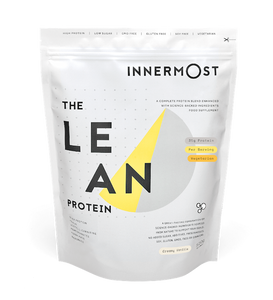
Our The Strong Protein packs 34g of protein into one low-calorie serving, with 3g of creatine built in (more on why that matters in a second). If your main focus is staying lean through the deficit, our Lean Protein is built with exactly that in mind, and if you're plant-based, our Health Protein gives you a vegan option without dropping the quality.
Creatine
Creatine is one of the most researched supplements on the planet, and a genuine ally when you're dieting. It supports your strength and helps you maintain lean mass while you train. It's already in The Strong Protein, or you can top up with The Power Booster, which is pure creatine monohydrate. Take 5 grams daily without fail; the timing matters far less than the consistency.
Hydration support
Given the digestive side effects and the natural dip in how much you're eating and drinking, an electrolyte blend like our Hydrate Blend can be a real help, especially on training days.
Everything we make at Innermost is built the same way: real, evidence-backed ingredients in doses that actually do something, with none of the filler or fairy dust. That matters more than ever when your appetite is limited, because every single serving has to pull its weight. If you want to see the full range, you can browse it all here.
Your GLP-1 Muscle-Preservation Playbook
If you skim everything else, don't skim this. Here's everything you need to know in 7 short points:
- Prioritise protein. Aim higher than feels natural, spread it across the day, and eat it first.
- Lift weights at least three times a week. Compound movements, gradually progressed. This is the big one.
- Keep some cardio in. Around 150 minutes a week, for your heart and your calorie deficit.
- Don't under-eat to extremes. A sensible deficit protects muscle. A savage one sacrifices it.
- Stay hydrated. Replace your fluids and electrolytes, especially if side effects hit.
- Use supplements to plug the gaps. A protein blend and creatine do real work when your appetite is low.
- Be patient. Body composition changes show up over months, not days. Trust the process.
One last, important word
These are powerful, prescription medications, and everyone responds to them a little differently. Nothing in this article is medical advice, and it's no substitute for the guidance of the doctor or prescriber looking after your treatment. If you've got questions about your medication, your dose, or anything that just doesn't feel right, please take those to them. They know your full picture in a way that an article never can.
What I can tell you, hand on heart, is this: being on a GLP-1 does not have to mean losing your muscle along with the fat. Treat it as a tool, pair it with proper protein, real training and a bit of smart support, and it can be the thing that finally gets you to a leaner, stronger version of yourself. Not just a smaller number on the scale, but a body that works as well as it looks.
Now that's a goal worth training for.